
The Four Pillars of Physical Longevity: A Science-Based Exercise Framework
Most people approach exercise with a single goal — lose weight, build muscle, train for a race, or simply move more. But when you examine exercise through the lens of longevity science, a more comprehensive framework emerges. The most influential exercise scientists and longevity physicians have converged on a model that identifies four distinct physical capacities, each essential for long-term health, each requiring deliberate training, and each protecting against different aspects of age-related decline. Understanding this exercise framework longevity four pillars transforms your training from random movement into a strategic investment in your future function and independence. The growing importance of exercise framework longevity four pillars cannot be overstated. At Curl Insurance Services, we believe that informed health strategies lead to better decisions about both wellness and coverage. #ExerciseFrameworkLongevityFourPillars
⠀
Why a Framework Matters
Without a comprehensive framework, most people’s exercise habits contain significant blind spots. The dedicated runner who never touches a weight is developing cardiovascular endurance while their muscle mass and bone density quietly erode. The weightlifter who skips cardio is building strength while their metabolic flexibility and cardiovascular health lag. The yoga practitioner who focuses exclusively on flexibility may maintain mobility while lacking the strength and cardiovascular capacity that predict longevity most powerfully.
⠀
The four-pillar framework addresses these blind spots by identifying the distinct physical capacities that collectively determine your healthspan, functional independence, and resilience against age-related decline. Each pillar targets different physiological systems, responds to different training stimuli, and protects against different aspects of aging. A training program that systematically develops all four pillars provides comprehensive protection that no single exercise modality can achieve alone.
⠀
Pillar One: Stability
Stability — the ability to maintain control of your body in space, protect your joints from injury, and move safely through a full range of motion — is the foundation upon which all other physical capacity is built. Without adequate stability, strength training becomes dangerous, cardiovascular training becomes inefficient, and daily activities increasingly risk injury.
As the landscape of exercise framework longevity four pillars continues to evolve, staying informed about the latest developments in exercise framework longevity four pillars becomes increasingly valuable for making evidence-based decisions about your health and financial future.
As the landscape of exercise framework longevity four pillars continues to evolve, staying informed about the latest developments in exercise framework longevity four pillars becomes increasingly valuable for making evidence-based decisions about your health and financial future.
⠀
What Stability Encompasses: Stability includes balance (the ability to maintain your center of gravity over your base of support), proprioception (your body’s awareness of its position in space), joint integrity (the ability of your joints to handle forces without pain or dysfunction), and core control (the ability of your trunk muscles to stabilize your spine during movement). These capacities decline measurably with age, and their loss is directly linked to falls, injuries, and the progressive movement dysfunction that erodes independence.
⠀
Training Stability: Stability training involves exercises that challenge balance and proprioception — single-leg stands, stability ball work, controlled movements on unstable surfaces — alongside targeted work for the deep stabilizing muscles of the core, hips, and shoulders. Practices like yoga and Pilates contribute to stability development, as do deliberate balance and proprioception drills incorporated into your regular training. Even simple practices like standing on one leg while brushing your teeth provide a daily stability stimulus.
⠀
Why It Matters for Longevity: Falls are the leading cause of injury-related death in older adults, and the inability to recover from a stumble is directly linked to stability deficits. Research has shown that simple balance tests — the ability to stand on one leg for ten seconds, for example — are remarkably predictive of mortality risk. Stability is the physical quality most directly linked to the prevention of the catastrophic events (falls, fractures, head injuries) that most frequently trigger the transition from independent to dependent living.
⠀
Pillar Two: Strength
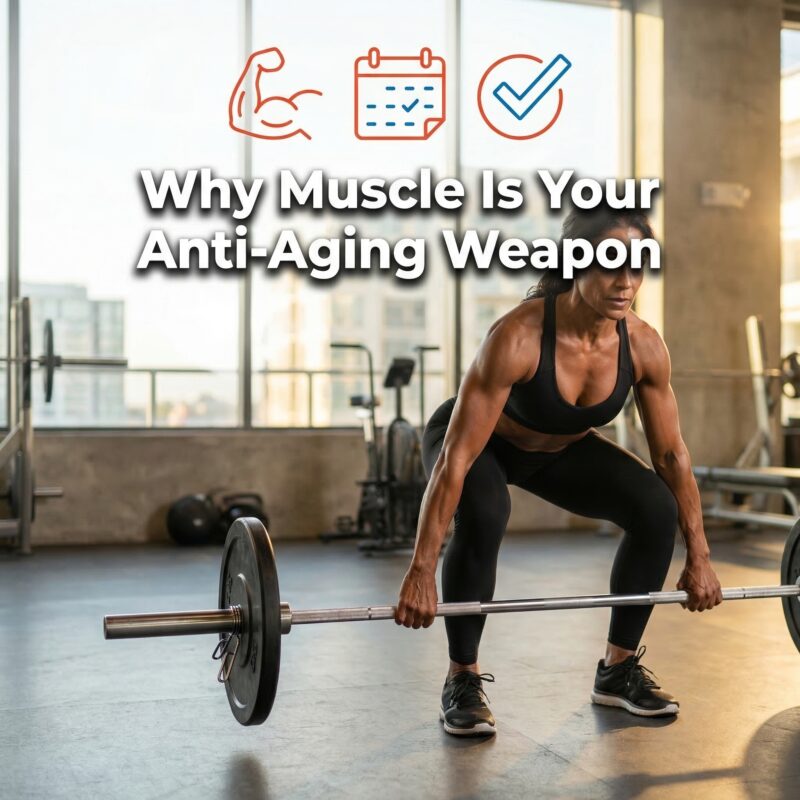
Strength — the ability to produce force against resistance — is the physical quality most directly protective against the age-related decline that erodes function, independence, and quality of life. Skeletal muscle is the organ of longevity, and maintaining its mass and function requires deliberate resistance training throughout the lifespan.
⠀
What Strength Encompasses: Functional strength includes the ability to squat (sit down and stand up), hip hinge (pick things up), push (open doors, place objects overhead), pull (carry loads, maintain posture), and grip (hold objects, support body weight). These fundamental movement patterns map directly onto the activities of daily living that define independent function. Strength also includes muscular endurance — the ability to sustain submaximal force production over time — which determines your capacity for extended physical tasks.
⠀
Training Strength: Effective strength training involves progressive resistance training targeting all major movement patterns, performed two to four times per week. Compound exercises — squats, deadlifts, bench press, rows, overhead press, and loaded carries — provide the most efficient stimulus for functional strength development. Progressive overload — gradually increasing the resistance, volume, or complexity of your training over time — drives continued adaptation regardless of your age or experience level.
⠀
Why It Matters for Longevity: Grip strength has emerged as one of the strongest single predictors of all-cause mortality in aging populations. Overall muscular strength correlates with reduced risk of cardiovascular disease, cancer, metabolic dysfunction, and disability. The protective mechanisms are multifaceted: stronger muscles improve metabolic health, protect bones from fracture, maintain functional independence, and provide the physical reserve needed to survive acute health challenges like surgery, infection, or hospitalization.
⠀
Pillar Three: Aerobic Efficiency (Zone 2)
Aerobic efficiency — your body’s capacity to produce energy through oxidative metabolism — is the metabolic engine that powers sustained physical activity and daily function. This pillar is developed primarily through Zone 2 cardiovascular training: sustained, moderate-intensity exercise that builds mitochondrial density, enhances fat oxidation, and improves the aerobic fitness that is the strongest single predictor of longevity.
The practical implications of exercise framework longevity four pillars extend far beyond theory, offering actionable insights for anyone committed to long-term wellness.
The practical implications of exercise framework longevity four pillars extend far beyond theory, offering actionable insights for anyone committed to long-term wellness.
⠀
What Aerobic Efficiency Encompasses: Aerobic efficiency reflects the health and density of your mitochondria, the capacity of your cardiovascular system to deliver oxygen to working tissues, and the metabolic flexibility to efficiently switch between fat and carbohydrate fuel sources based on demand. It determines your ability to sustain moderate physical activity — walking, cycling, swimming, gardening — for extended periods without fatigue, and it provides the cardiovascular reserve needed to respond to physiological stress.
⠀
Training Aerobic Efficiency: Zone 2 training — sustained cardiovascular exercise at an intensity where you can maintain conversation but prefer not to — is the primary stimulus for developing aerobic efficiency. Three to four sessions per week, each lasting forty-five to sixty minutes, provides the training volume that drives meaningful mitochondrial adaptation. The specific activity matters less than the consistency and appropriate intensity: walking, cycling, swimming, rowing, or any sustained cardiovascular activity performed at Zone 2 intensity develops this pillar effectively.
⠀
Why It Matters for Longevity: VO2 max — the gold-standard measurement of aerobic capacity — is the single strongest predictor of all-cause mortality. Individuals in the top fitness quartile for their age have dramatically lower mortality rates than those in the bottom quartile, with risk reductions that exceed the benefit of most pharmaceutical interventions. Aerobic efficiency also underpins metabolic health, cognitive function, and the stamina needed to enjoy an active, engaged life throughout your later decades.
⠀
Pillar Four: Anaerobic Performance (Zone 5)
Anaerobic performance — your body’s capacity for short-duration, high-intensity effort — develops the peak cardiovascular output, glycolytic capacity, and neuromuscular power that Zone 2 training alone cannot address. This pillar directly improves VO2 max, maintains fast-twitch muscle fiber recruitment, and builds the explosive capacity needed for real-world demands like sprinting to catch a bus, climbing a steep flight of stairs, or recovering from a stumble.
⠀
What Anaerobic Performance Encompasses: This pillar reflects your capacity to produce energy through anaerobic pathways, your peak cardiovascular output, and your ability to tolerate and clear metabolic byproducts like lactate. It determines your ceiling of physical performance — how hard you can push when maximum effort is required — and maintaining this ceiling has direct implications for both functional capacity and VO2 max.
⠀
Training Anaerobic Performance: High-intensity interval training — structured sessions alternating between near-maximal effort and recovery — is the primary tool for developing anaerobic performance. One to two HIIT sessions per week, with intervals typically lasting three to five minutes at ninety to ninety-five percent of maximum heart rate, provides sufficient stimulus without creating excessive recovery demands that would compromise your other training pillars. Common formats include cycling or rowing intervals, hill repeats, and structured sprint sessions.
⠀
Why It Matters for Longevity: VO2 max improvement requires high-intensity stimulation that Zone 2 alone cannot provide. Maintaining fast-twitch muscle fibers — which are preferentially lost during aging — requires the recruitment that only high-intensity effort triggers. And the real-world scenarios that determine whether a moment of physical crisis (a near-fall, a sudden exertion, a physical emergency) resolves safely or catastrophically depend on your peak physical capacity, not your steady-state endurance.
⠀
Programming the Four Pillars Together
The practical challenge is fitting all four pillars into a sustainable weekly training schedule. A well-designed program balances training volume across pillars while respecting recovery capacity and accommodating the realities of a busy life.
⠀
A Sample Weekly Framework: A comprehensive longevity training week might include three to four Zone 2 cardiovascular sessions of forty-five to sixty minutes, two to three strength training sessions incorporating compound movements with progressive overload, one to two high-intensity interval sessions of twenty to thirty minutes including warm-up and cool-down, and stability and mobility work integrated into warm-ups, cool-downs, or dedicated ten-to-fifteen-minute daily sessions. Some sessions can combine pillars — a strength session preceded by a stability-focused warm-up, or a Zone 2 session followed by a brief HIIT finisher — making the total time commitment more manageable.
⠀
Assessing Your Weaknesses: Honest self-assessment of your current capacity across all four pillars helps you prioritize your training investment. Most people will find one or two pillars significantly underdeveloped relative to the others. A dedicated runner may need to prioritize strength and stability. A weightlifter may need to emphasize aerobic efficiency. Someone returning to exercise after a sedentary period may need to build foundational stability before adding significant training load in other pillars. Addressing your weakest pillar typically produces the greatest marginal health improvement.
⠀
Adjusting Across the Lifespan: The relative emphasis across pillars should shift as you age. In your forties and fifties, building a robust training foundation across all four pillars is the priority. In your sixties and seventies, stability and strength deserve increasing emphasis as fall prevention and functional independence become more pressing concerns. Cardiovascular training remains important throughout, but the risk-benefit calculus of high-intensity work shifts as recovery capacity decreases and injury risk increases with advancing age.
⠀
Why This Matters for Your Health Strategy
The conversation around exercise framework longevity four pillars is more relevant than ever. As research into exercise framework longevity four pillars accelerates, individuals who stay informed position themselves to make smarter decisions about their health and coverage. Whether you are just beginning to explore exercise framework longevity four pillars or have been following these developments closely, the evidence suggests that proactive engagement with exercise framework longevity four pillars can yield meaningful benefits over time.
Related Reading from Our Longevity Series
Continue exploring exercise framework longevity four pillars and related longevity topics with these in-depth guides:
- Don’t Die: What Netflix’s Hit Longevity Documentary Teaches About Human Potential
- Telemedicine Meets Longevity: Accessing Cutting-Edge Health Optimization from Anywhere
- Healthspan vs. Lifespan: Why Living Better Matters More Than Living Longer
The Coverage Case for Comprehensive Fitness
The four-pillar exercise framework directly addresses the physical capacities most strongly associated with reduced healthcare utilization, lower chronic disease incidence, maintained independence, and extended lifespan. Individuals who systematically develop all four pillars experience fewer falls, fewer fractures, fewer metabolic diseases, fewer cardiovascular events, and maintain functional independence longer than those who exercise haphazardly or not at all.
⠀
The services that support comprehensive fitness programming — exercise testing, VO2 max assessment, body composition analysis, personalized program design, and ongoing progress monitoring — are most accessible through concierge medicine practices where they form part of holistic health optimization programs. These clinical services transform exercise from guesswork into data-driven practice, ensuring your training investment produces measurable health returns.
⠀
At Curl Insurance Services, we help clients across Arizona, Florida, Georgia, Louisiana, Michigan, North Carolina, Ohio, South Carolina, and Texas build coverage strategies that protect and support active lifestyles. Accident insurance provides essential protection for individuals engaged in regular physical training. Dental and vision coverage addresses the health dimensions that exercise alone cannot optimize. Foundation health insurance provides the safety net for serious health events. And concierge medicine access ensures your training is guided by objective data and physician expertise.
⠀
The Kaiser Family Foundation continues to document the staggering healthcare costs attributable to physical inactivity and its consequences — making the four-pillar framework not just a health strategy but a financial one as well.
⠀
Text us at (949) 506-2746 to explore coverage that matches your commitment to comprehensive physical longevity. Our advisors at Curl Insurance Services design coverage strategies worthy of the investment you make in your health every day.
⠀