
AI drug discovery aging longevity represents one of the most transformative convergences in modern science — as artificial intelligence compresses drug development timelines from decades to years, the possibility of clinically validated age-reversal therapies is moving from theoretical to imminent. #AIDrugDiscoveryAgingLongevity
⠀
The traditional drug discovery process is notoriously slow and expensive. On average, bringing a new drug from initial discovery to market approval takes twelve to fifteen years and costs over two billion dollars. For longevity therapeutics specifically, the challenge has been even greater because aging itself was not historically recognized as a treatable condition. Artificial intelligence is fundamentally changing both of these constraints, accelerating the identification, design, and testing of compounds that could slow, halt, or reverse biological aging.
⠀
How AI Transforms the Drug Discovery Pipeline
⠀
Traditional drug discovery begins with screening millions of chemical compounds to find those that interact with a specific biological target. This process alone can take three to five years using conventional laboratory methods. AI systems can analyze the molecular structure of potential drug candidates and predict their interactions with biological targets in a fraction of the time. Machine learning models trained on vast datasets of known drug-target interactions can identify promising candidates in days rather than years.
⠀
Beyond initial screening, AI accelerates every subsequent stage of development. It predicts pharmacokinetics — how a drug is absorbed, distributed, metabolized, and excreted — before expensive animal studies. It identifies potential toxicity issues early, reducing the failure rate that makes traditional drug development so costly. It optimizes molecular structures to improve efficacy and reduce side effects through iterative computational design. And it can identify new therapeutic applications for existing approved drugs, potentially bypassing years of safety testing.
⠀
AlphaFold and the Protein Folding Revolution
⠀
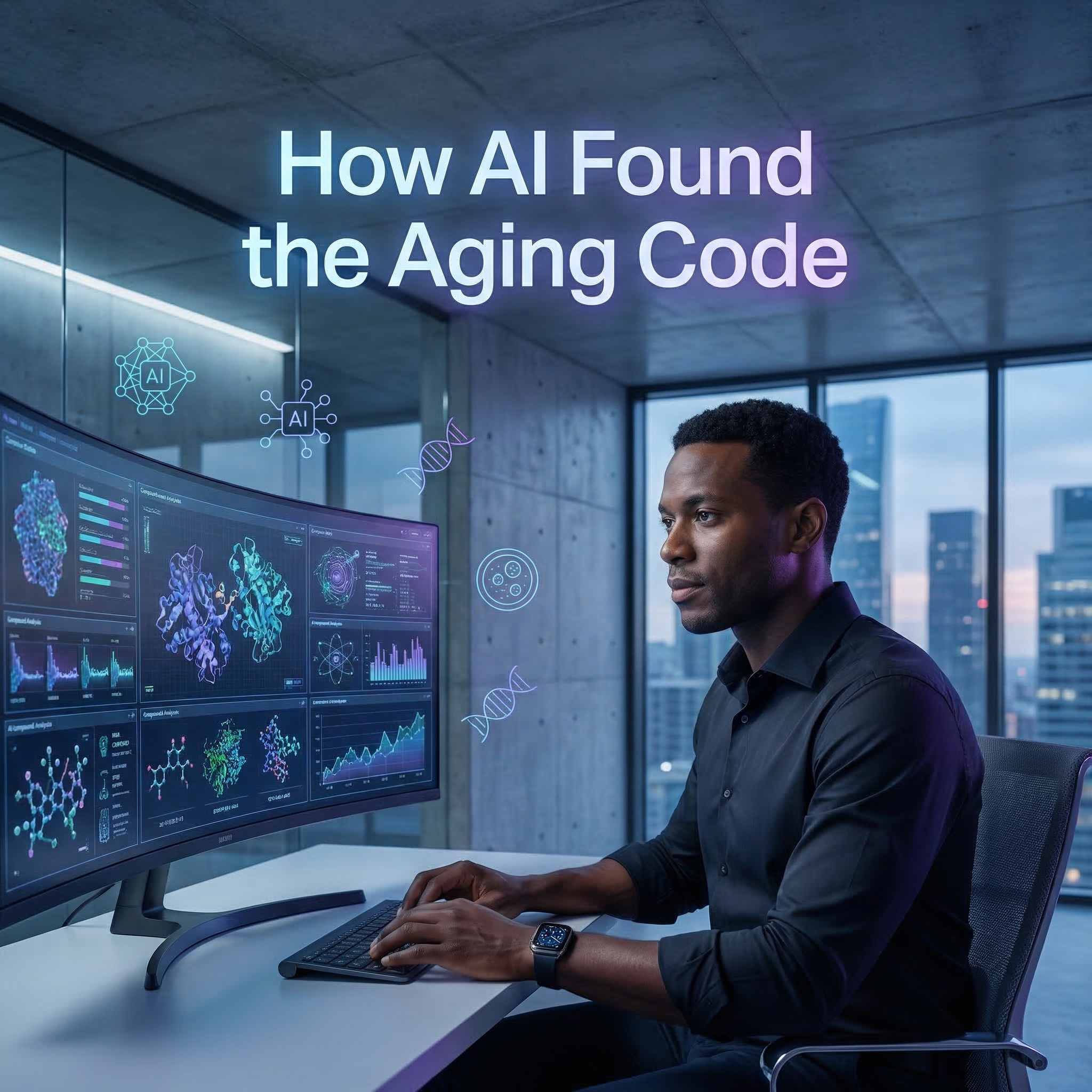
The breakthrough that most dramatically illustrated AI’s potential in biological research was DeepMind’s AlphaFold, which solved the protein folding problem — a challenge that had stumped biologists for fifty years. By predicting the three-dimensional structure of virtually every known protein, AlphaFold provided researchers with a comprehensive structural atlas of biology. This atlas is now accelerating drug design by revealing the precise shapes of the molecular targets that drugs must bind to.
⠀
For aging research specifically, AlphaFold’s protein structure predictions have enabled the identification of new drug targets in pathways central to the aging process. Researchers can now design molecules that precisely fit into the active sites of enzymes involved in cellular senescence, mitochondrial dysfunction, and inflammatory signaling with unprecedented accuracy. This structural understanding transforms drug design from a process of trial and error into one of rational, targeted engineering.
⠀
AI-Identified Senolytic Candidates
⠀
As the landscape of AI drug discovery aging longevity continues to evolve, staying informed about the latest developments in AI drug discovery aging longevity becomes increasingly valuable for making evidence-based decisions about your health and financial future.
As the landscape of AI drug discovery aging longevity continues to evolve, staying informed about the latest developments in AI drug discovery aging longevity becomes increasingly valuable for making evidence-based decisions about your health and financial future.
Senolytics — drugs that selectively eliminate senescent cells, the dysfunctional cells that accumulate with age and drive inflammation and tissue degradation — are among the most promising classes of longevity therapeutics. AI has dramatically expanded the pipeline of potential senolytic compounds by screening vast chemical libraries against the specific molecular signatures of senescent cells. Several AI-identified senolytic candidates have shown impressive results in preclinical studies and are advancing toward human trials.
⠀
The advantage of AI-designed senolytics over earlier candidates is precision. First-generation senolytics like dasatinib and quercetin were repurposed from cancer therapy and affect multiple cell types beyond just senescent cells. AI-designed compounds can be engineered for greater selectivity, potentially reducing side effects while increasing efficacy against senescent cell populations. This precision approach exemplifies how AI does not just speed up drug discovery — it fundamentally improves the quality of the compounds being developed.
⠀
Computational Modeling of Aging Pathways
⠀
AI systems are uniquely capable of modeling the extraordinary complexity of aging biology. Aging is not caused by a single gene or pathway — it is the result of interconnected processes including genomic instability, telomere attrition, epigenetic changes, loss of proteostasis, mitochondrial dysfunction, cellular senescence, stem cell exhaustion, and altered intercellular communication. Understanding how these processes interact and influence each other requires the kind of multi-dimensional analysis that exceeds human cognitive capacity but is well-suited to machine learning.
⠀
Researchers are using AI to build comprehensive computational models of aging that integrate data from genomics, proteomics, metabolomics, and clinical outcomes. These models can identify intervention points where a single drug or combination therapy could have cascading beneficial effects across multiple aging pathways simultaneously. This systems-level understanding is essential for developing therapies that address aging holistically rather than treating isolated symptoms.
⠀
Drug Repurposing: Finding Longevity in Existing Medications
⠀
The practical implications of AI drug discovery aging longevity extend far beyond theory, offering actionable insights for anyone committed to long-term wellness.
The practical implications of AI drug discovery aging longevity extend far beyond theory, offering actionable insights for anyone committed to long-term wellness.
One of AI’s most immediately impactful applications in longevity medicine is drug repurposing — identifying existing, approved medications that may have anti-aging properties beyond their original indication. Metformin, rapamycin, and GLP-1 receptor agonists were all originally developed for conditions other than aging but have shown remarkable longevity-related benefits that are now being formally studied. AI is systematically screening the entire pharmacopoeia for similar hidden longevity effects.
⠀
The advantage of repurposing is speed. Because these drugs have already been through safety testing and regulatory approval, they can move to clinical trials for new indications much faster than novel compounds. AI analysis of electronic health records, combined with molecular modeling, can identify patterns suggesting that patients taking certain medications age more slowly or have lower rates of age-related diseases. These observational signals can then be confirmed through targeted clinical trials.
⠀
The TAME Trial and Metformin’s AI-Assisted Validation
⠀
The Targeting Aging with Metformin trial represents a landmark in longevity research — the first clinical trial specifically designed to test whether a drug can slow the aging process in humans. While metformin was not discovered by AI, computational analysis of its mechanisms and patient outcome data has been instrumental in building the case for the trial and designing its protocol. AI models predicted which patient populations would show the strongest response and identified the most sensitive biomarkers for measuring anti-aging effects.
⠀
The significance of TAME extends beyond metformin itself. If the trial succeeds in demonstrating that aging can be pharmacologically delayed, it will establish a regulatory framework for approving anti-aging drugs — something that does not currently exist. This framework would accelerate the path to market for the many AI-discovered longevity compounds currently in development, potentially opening a floodgate of new therapies over the following decade.
⠀
Generative AI and De Novo Drug Design
⠀
The latest frontier in AI drug discovery is generative design — using AI systems to create entirely novel molecular structures optimized for specific therapeutic targets. Rather than screening existing chemical libraries, generative AI models can design new molecules from scratch, exploring chemical space that has never been synthesized or tested. These systems can simultaneously optimize for multiple properties including target binding affinity, selectivity, bioavailability, and predicted safety.
⠀
Several biotech companies are now using generative AI to design longevity therapeutics. Insilico Medicine has advanced an AI-designed drug to clinical trials in record time, demonstrating the practical viability of this approach. As generative AI models become more sophisticated and training datasets grow, the ability to design precisely targeted aging interventions will continue to improve exponentially.
⠀
What This Means for Insurance and Healthcare Planning
⠀
The acceleration of longevity drug discovery has profound implications for healthcare and insurance. As new anti-aging therapies reach market, they will create entirely new categories of medical spending. Some will be covered by insurance relatively quickly — particularly those based on repurposed medications with established safety profiles. Others, especially novel compounds targeting aging directly, may face longer paths to coverage as the insurance industry adapts to the concept of treating aging as a medical condition.
⠀
Forward-thinking individuals should prepare for this evolving landscape by building flexible health coverage strategies. Plans with strong prescription drug benefits will become increasingly valuable as longevity pharmaceuticals reach market. HSA accounts provide tax-advantaged savings for therapies that may initially fall outside standard coverage. And relationships with concierge medicine physicians who stay current with longevity research ensure that you will have access to new therapies as they become available, even before they become mainstream.
⠀
The Timeline: When Will AI-Discovered Longevity Drugs Arrive?
⠀
Credible estimates suggest that the first wave of AI-discovered or AI-optimized longevity therapeutics will reach clinical availability within three to seven years. Repurposed medications like optimized metformin analogs and next-generation GLP-1 compounds are closest to market. Novel senolytics and epigenetic reprogramming agents are in earlier stages but advancing rapidly. By the early 2030s, a meaningful pharmacological toolkit for addressing biological aging is likely to exist.
⠀
This timeline matters for your health decisions today. Every year that you maintain optimal health through lifestyle interventions, preventive care, and strategic health management is a year closer to having access to these transformative therapies. Investing in your health now is not just about today’s benefits — it is about ensuring you are in the best possible position to take advantage of the extraordinary advances that are coming.
⠀
Why This Matters for Your Health Strategy
The conversation around AI drug discovery aging longevity is more relevant than ever. As research into AI drug discovery aging longevity accelerates, individuals who stay informed position themselves to make smarter decisions about their health and coverage. Whether you are just beginning to explore AI drug discovery aging longevity or have been following these developments closely, the evidence suggests that proactive engagement with AI drug discovery aging longevity can yield meaningful benefits over time.
Related Reading from Our Longevity Series
Continue exploring AI drug discovery aging longevity and related longevity topics with these in-depth guides:
- The $111 Million Bet on Reversing Aging: Inside the XPRIZE Healthspan Challenge
- Why Traditional Health Insurance Wasn’t Built for Longevity — And What to Do About It
- NAD+ and Longevity: Separating Science from Supplement Industry Hype
Preparing Your Health Infrastructure for the Longevity Revolution
⠀
At Curl Insurance Services, we help clients build health coverage strategies that are both effective today and adaptable for tomorrow’s rapidly evolving longevity landscape. Whether you are optimizing your current preventive care benefits, exploring concierge medicine for access to cutting-edge health management, or building an HSA strategy to fund future longevity therapies, we provide the guidance to align your coverage with your goals. The AI-driven longevity revolution is accelerating — make sure your health infrastructure is ready. Text us at (949) 506-2746 to start planning.