
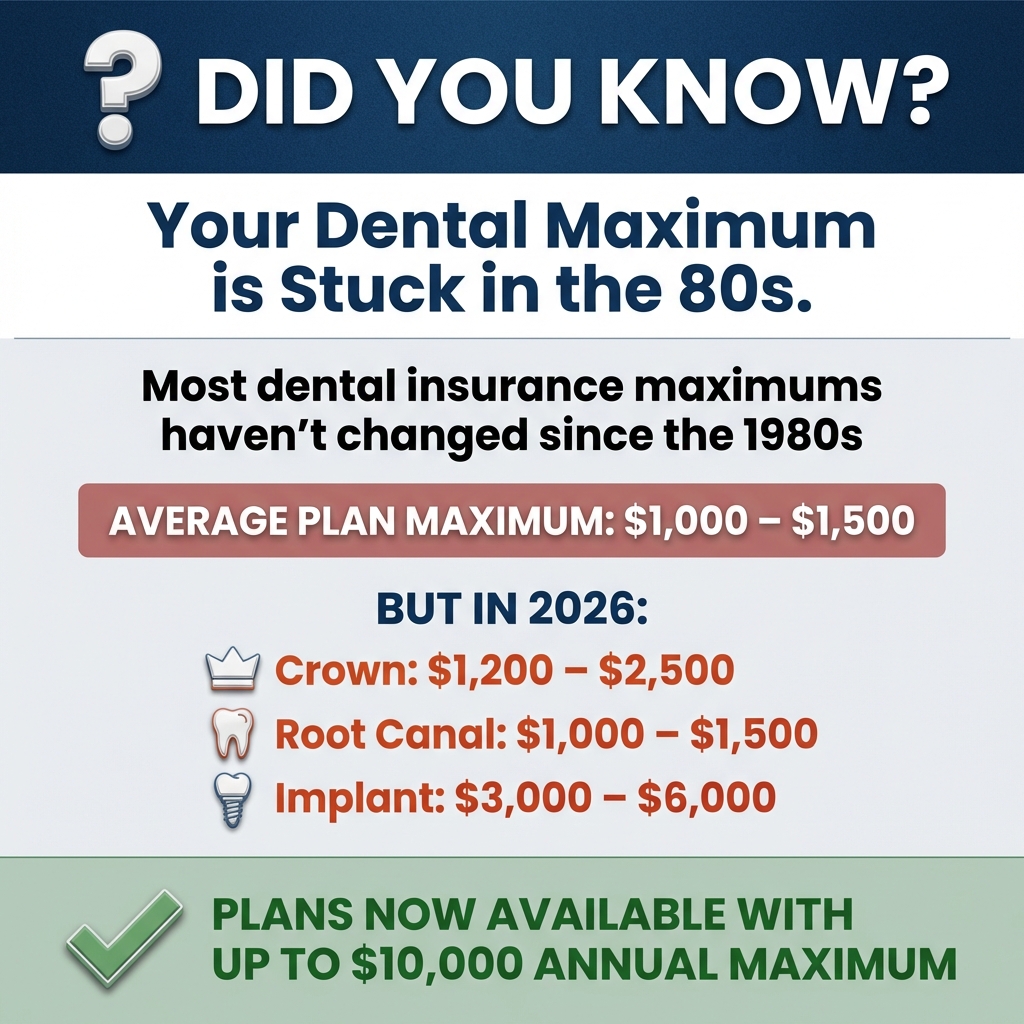
Dental insurance annual maximum limits are stuck in the past—and it’s costing you. #DentalInsuranceAnnualMaximum Here’s an uncomfortable truth that most people don’t realize: your plan’s annual maximum probably hasn’t meaningfully increased since the 1980s. While dental costs have risen dramatically over four decades, the average plan still caps coverage at $1,000 to $1,500 per year.
⠀
In this eye-opening guide, we’ll explore why this matters for your wallet, how a single dental procedure can wipe out your entire year’s benefits, and what options exist for people who want coverage that actually keeps pace with modern dental costs.
⠀
The Startling Reality of Dental Insurance Maximums
⠀
When dental insurance became widely available in the 1970s and 1980s, annual maximums of $1,000 to $1,500 were set based on the dental costs of that era. The assumption was that these limits would increase over time as dental costs rose.
⠀
That assumption proved wrong.
⠀
According to industry analyses, the average dental insurance annual maximum has remained essentially flat for over 40 years. Meanwhile, dental care costs have increased by approximately 400-500% during the same period.
⠀
If dental insurance maximums had kept pace with inflation, a $1,500 maximum from 1985 would be worth approximately $4,200 today. If they had kept pace with actual dental cost increases, that figure would be even higher.
⠀
Instead, most Americans still have the same $1,500 cap their parents had decades ago.
⠀
What This Means in Real Dollars
⠀
Let’s put this in perspective with 2026 dental costs:
⠀
**Single crown:** $1,200 – $2,500
⠀
A crown—one of the most common major dental procedures—can consume 80% to 167% of your entire annual maximum. One procedure, one year of benefits gone.
⠀
**Root canal plus crown:** $2,500 – $4,000
⠀
When a tooth becomes infected, root canal therapy followed by a protective crown is standard treatment. This single treatment course can exceed your annual maximum by $1,000 to $2,500.
⠀
**Dental implant:** $3,000 – $6,000
⠀
Implants are the gold standard for replacing missing teeth. A single implant costs two to four times the average annual maximum. With a $1,500 cap, you’re paying $1,500 to $4,500 out of pocket—for one tooth.
⠀
**Multiple crowns or implants:** $5,000 – $20,000+
⠀
Many people need multiple restorations as they age. With a $1,500 annual maximum, completing this work takes years of waiting or massive out-of-pocket payments.
⠀
The math is brutal: modern dental procedures regularly cost more than outdated annual maximums cover.
⠀
Why Haven’t Maximums Increased?
⠀
If this situation seems unfair, you’re not alone. So why haven’t insurance companies increased annual maximums to keep pace with costs?
⠀
**Employer-sponsored plans dominate the market:** Most dental insurance is provided through employers, who select plans based on premium cost. Lower maximums mean lower premiums, which look better on benefits packages even if the actual coverage is inadequate.
⠀
**Consumer awareness is low:** Most people don’t think about their dental maximum until they need expensive work. By then, they’re locked into their plan for the year.
⠀
**Dental insurance economics differ from medical:** Unlike medical insurance, where catastrophic costs can reach millions, dental costs have a ceiling. Insurers know the maximum exposure and price accordingly—often prioritizing their profit margins over adequate coverage.
⠀
**Tradition and inertia:** “That’s how it’s always been done” is a powerful force in insurance. Plans that worked (sort of) in 1985 continue to be sold in 2026, even though they no longer provide meaningful protection.
⠀
The Hidden Costs of Inadequate Maximums
⠀
Low annual maximums don’t just mean higher out-of-pocket costs. They create ripple effects that impact your overall dental health:
⠀
Delayed Treatment
⠀
When people realize their insurance won’t cover needed work, they often delay treatment. A crown that should be done this year gets pushed to next year to “spread out” the costs across multiple benefit years.
⠀
This delay frequently backfires. The tooth that needed a crown may now need a root canal. The tooth that needed a root canal may now need extraction. What would have been a $1,500 procedure becomes a $5,000 ordeal.
⠀
Compromised Treatment Choices
⠀
Patients with inadequate coverage sometimes choose lesser treatments to fit within their benefits. Instead of an implant (the best solution), they choose a bridge. Instead of a bridge, they choose to leave the gap.
⠀
These compromises can affect chewing function, adjacent tooth health, and long-term oral health outcomes.
⠀
Financial Stress
⠀
Unexpected dental expenses create real financial hardship. When a $3,000 procedure is only covered at $750 (50% of the $1,500 maximum), the $2,250 gap comes directly from emergency funds, credit cards, or foregone treatment.
⠀
This stress affects not just finances but overall wellbeing and the relationship between patients and their dental care.
⠀
What Adequate Coverage Actually Looks Like
⠀
If $1,500 is inadequate, what annual maximum actually provides meaningful protection?
⠀
**$5,000 annual maximum:** Covers most routine years plus one major procedure. Provides genuine protection against typical dental needs.
⠀
**$10,000 annual maximum:** Handles virtually any dental situation short of full-mouth reconstruction. Provides true peace of mind for most individuals and families.
⠀
**Separate implant benefits:** The best plans provide dedicated implant coverage that doesn’t count against the regular annual maximum. This recognizes that implants are increasingly common and genuinely expensive.
⠀
These coverage levels exist. They’re just not what most employer plans offer because they cost more in premiums.
⠀
Premium Dental Plans: What’s Available in 2026
⠀
For those seeking coverage that actually matches modern dental costs, premium individual dental plans offer what employer coverage often doesn’t:
⠀
NCD Complete by MetLife
⠀
**Annual maximum:** $10,000
**Implant coverage:** Additional $3,000 per year (separate from annual maximum)
**Total annual coverage:** Up to $13,000
⠀
This is the highest annual maximum available on the individual dental insurance market. It provides genuine protection against virtually any dental situation.
⠀
**Coverage levels:**
– Preventive care: 100% (three cleanings per year)
– Basic procedures: 80%
– Major procedures: 50%
– Implants: 50% of the separate $3,000 allowance
⠀
**Waiting periods:** None. All services covered from day one.
⠀
NCD Elite 5000 by MetLife
⠀
**Annual maximum:** $5,000
**Implant coverage:** Additional $2,500 per year
⠀
For those wanting strong protection without the highest premium tier, Elite 5000 provides three times the coverage of typical employer plans.
⠀
**Coverage levels:**
– Preventive care: 100%
– Basic procedures: 80%
– Major procedures: 50%
⠀
**Waiting periods:** None.
⠀
Comparing to Typical Employer Plans
⠀
| Feature | Typical Employer Plan | NCD Elite 5000 | NCD Complete |
|———|———————-|—————-|————–|
| Annual Maximum | $1,500 | $5,000 | $10,000 |
| Implant Coverage | Often excluded | $2,500 additional | $3,000 additional |
| Cleanings/Year | 2 | 2 | 3 |
| Waiting Periods | Often 6-12 months | None | None |
⠀
The premium difference is real—but so is the coverage difference.
⠀
Real Scenarios: Why Maximums Matter
⠀
Let’s walk through actual situations where annual maximum makes a significant financial difference:
⠀
Scenario 1: Unexpected Crown Need
⠀
You’ve been diligent about dental care, but at your checkup, your dentist discovers an old filling has failed. You need a crown immediately.
⠀
**With $1,500 maximum (50% major coverage):**
– Crown cost: $1,800
– Insurance pays: $900 (50%)
– But wait—you already used $400 on cleanings
– Actual insurance payment: $700 (remaining maximum)
– Your out-of-pocket: $1,100
⠀
**With $10,000 maximum (50% major coverage):**
– Crown cost: $1,800
– Insurance pays: $900 (50%)
– Your out-of-pocket: $900
– Remaining annual maximum: $8,600 for any other needs
⠀
Scenario 2: Root Canal Plus Crown
⠀
A tooth becomes painful. Diagnosis: infection requiring root canal therapy, followed by a crown.
⠀
**With $1,500 maximum:**
– Root canal: $1,200
– Crown: $1,800
– Total: $3,000
– Insurance pays: $1,500 (maximum reached after partial coverage)
– Your out-of-pocket: $1,500+
⠀
**With $10,000 maximum:**
– Root canal: $1,200 at 80% = $960 covered
– Crown: $1,800 at 50% = $900 covered
– Total insurance pays: $1,860
– Your out-of-pocket: $1,140
– Remaining annual maximum: $7,740
⠀
Scenario 3: Dental Implant
⠀
You lose a tooth and want the best replacement option.
⠀
**With $1,500 maximum (implants often excluded):**
– Implant cost: $4,500
– Insurance pays: $0 (excluded or $750 if covered at 50%)
– Your out-of-pocket: $3,750 – $4,500
⠀
**With NCD Complete ($10,000 max + $3,000 implant benefit):**
– Implant cost: $4,500
– Insurance pays: $1,500 (50% of $3,000 implant benefit)
– Your out-of-pocket: $3,000
– Note: Regular annual maximum untouched for other procedures
⠀
How to Evaluate Your Current Coverage
⠀
Before deciding whether to upgrade your dental coverage, honestly assess what you have:
⠀
**Find your annual maximum:** It’s in your benefits summary or explanation of benefits. If you can’t find it easily, that’s often a sign it’s not prominently featured for a reason.
⠀
**Check your implant coverage:** Is implant coverage included? At what percentage? With what limitations?
⠀
**Review waiting periods:** Can you get major work done immediately, or are there waiting periods?
⠀
**Calculate your family’s potential needs:** Be honest about your dental history and likely future needs. If you’ve needed major work before, you’ll probably need it again.
⠀
**Compare total annual cost to potential benefits:** Include premiums, copays, and maximum coverage. Does the math work for your situation?
⠀
Making the Switch to Better Coverage
⠀
If your current coverage falls short, you have options:
⠀
**Individual dental plans:** Available year-round with no open enrollment restrictions. You can purchase coverage whenever you decide you need it.
⠀
**Supplemental coverage:** Some people add individual coverage on top of employer plans to increase their effective annual maximum.
⠀
**HSA/FSA funds:** If you have a health savings account or flexible spending account, you can use these tax-advantaged funds for dental expenses your insurance doesn’t cover.
⠀
**Payment plans:** Many dental offices offer payment plans for major work. Combined with better insurance, this can make even expensive treatment manageable.
⠀
The Bottom Line on Annual Maximums
⠀
Your dental insurance annual maximum matters—far more than most people realize until they need significant work. A $1,500 maximum made sense in 1985. It doesn’t make sense in 2026.
⠀
Modern dental costs demand modern coverage. Plans with $5,000 to $10,000 annual maximums exist specifically to address this reality. They cost more in premium, but they provide actual protection instead of the illusion of coverage.
⠀
We help individuals and families find dental coverage with annual maximums that match today’s actual dental costs. Whether you need maximum protection with NCD Complete’s $10,000 limit or balanced coverage with Elite 5000’s $5,000 maximum, we can help you understand your options.
⠀
**Don’t let your dental coverage remain stuck in the 1980s.**
⠀
**→ Get Your Coverage Quote:**
⠀
**→ Compare Plan Options:**
⠀
Questions about annual maximums or coverage options? Text us at (949) 506-2746 or email info@curlinsuranceservices.com. We’ll help you find coverage that actually protects you.